Y-Wing in sudoku uses three cells to cross out one digit
A Y-Wing is three cells with exactly two candidates each. The pivot holds X and Y. It sees one pincer with X and Z and a second pincer with Y and Z. Whatever the pivot turns out to be, one pincer must be Z, so a cell that sees both pincers cannot be Z. Cross Z out of those cells. Look for it once your pencil marks are complete and the singles, pairs and X-Wings have dried up.
What is a Y-Wing in sudoku?
A Y-Wing is an elimination pattern built from three cells that each hold two candidates. It places no digit. It removes one candidate, Z, from the cells that see both ends of the pattern. Two cells see each other when they share a row, a column or a box.
The cell that links the other two is the pivot, with candidates X and Y. The other two cells are the pincers, and each one sees the pivot. One pincer holds X and Z, the other holds Y and Z. Z is the digit the pattern removes. The pivot does not hold it.
Is a Y-Wing the same as an XY-Wing?
Yes. Y-Wing and XY-Wing are two names for one pattern. SudokuWiki describes it as the Y-Wing and the HoDoKu solver documents it as the XY-Wing, with the same definition: a two-candidate pivot, two pincers that each see it, and a third digit the pincers share.
The XYZ-Wing is a different pattern. Its pivot holds three candidates, X, Y and Z, so Z can only be removed from cells that see the pivot and both pincers. HoDoKu calls it an enhanced version of the XY-Wing. If the cell you picked as a pivot has three candidates, you are looking at an XYZ-Wing and its smaller elimination zone.
Why does a cell that sees both pincers lose Z?
Follow the two possible values of the pivot. If the pivot is X, the pincer holding X and Z sees it and cannot be X, so that pincer is Z. If the pivot is Y, the other pincer becomes Z for the same reason. You can't tell yet which pincer gets the Z, only that one of them does. A cell that sees both pincers sees a Z either way, so Z cannot go there.
What does a Y-Wing look like on a real grid?
The grid below comes from the SudoKoum generator, and a second script redoes the whole calculation on its own. At this point, the simpler techniques, from singles up to the X-Wing, no longer place any digit. Cells are named by row and column, so r6c8 is row 6, column 8. Only the candidates of the six cells involved are shown.
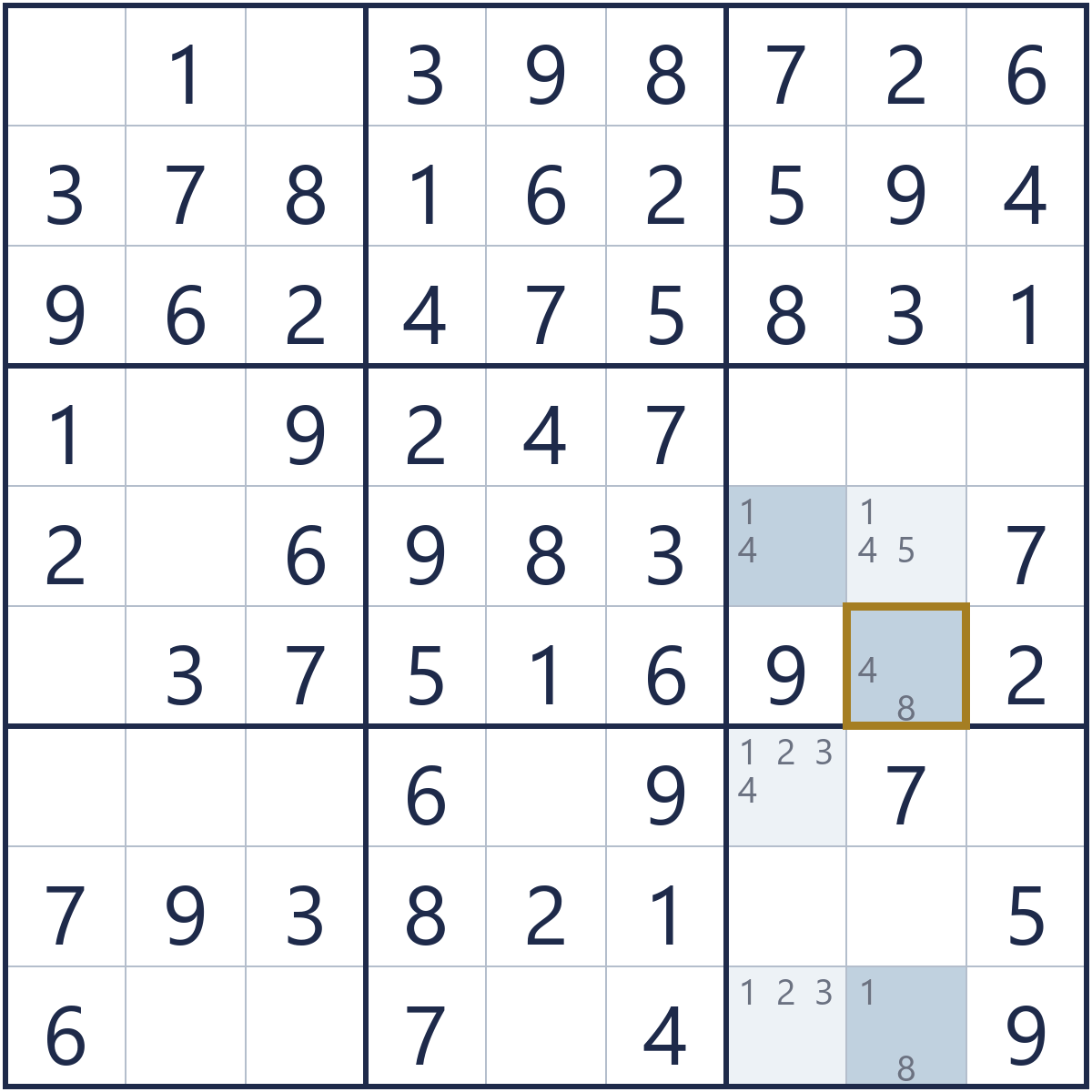
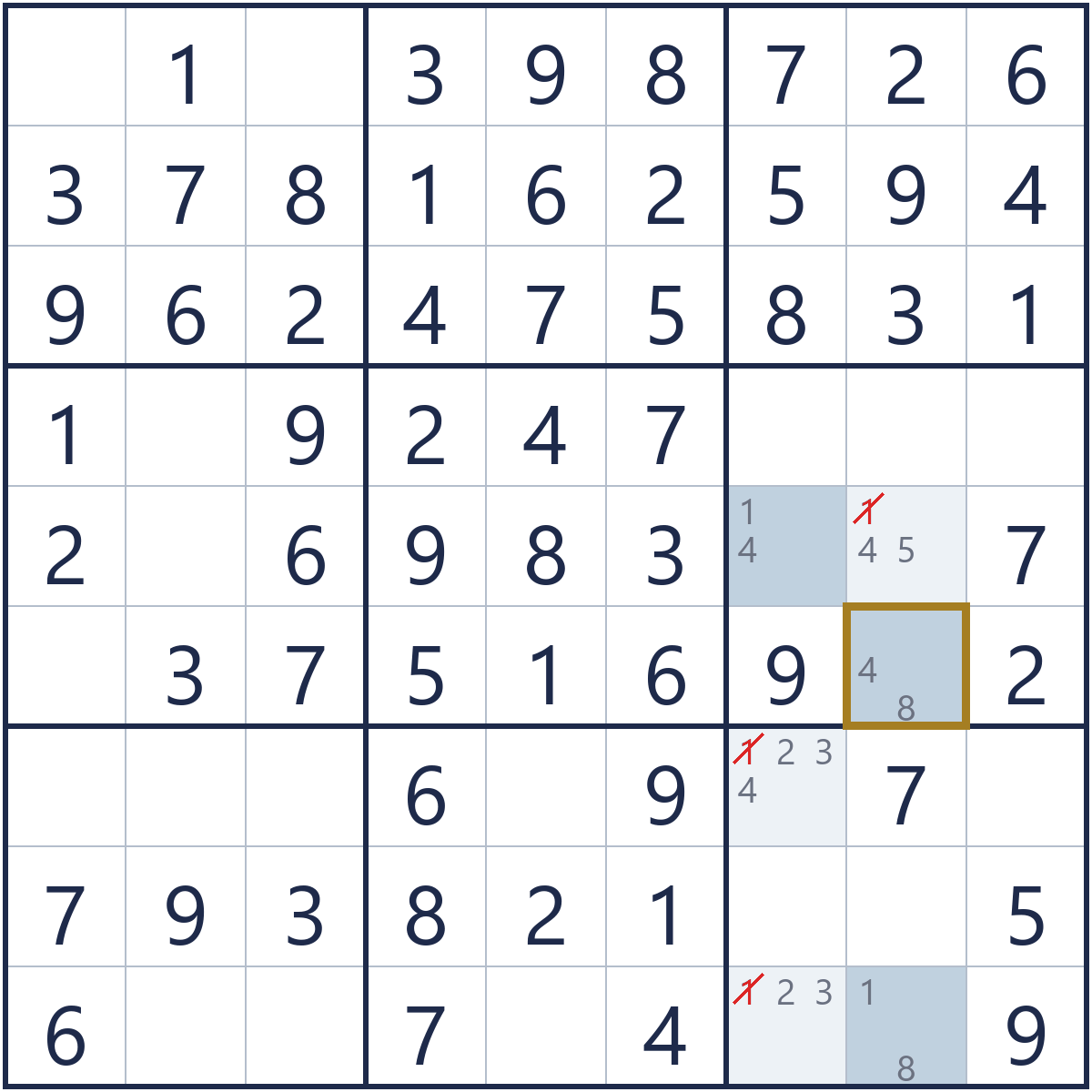
- Start from the pivot, r6c8, with candidates 4 and 8.
- Find a pincer for the 4 among the cells the pivot sees. Cell r5c7 shares its box and holds 1 and 4.
- Find a pincer for the 8. Cell r9c8 shares column 8 with the pivot and holds 1 and 8. The digit both pincers share is 1, so Z is 1.
- List the cells that see both r5c7 and r9c8 and still hold a 1. Cell r5c8 sees r5c7 along row 5 and r9c8 along column 8. Cell r7c7 sees r5c7 along column 7 and r9c8 through the bottom-right box. Cell r9c7 sees r5c7 along column 7 and r9c8 along row 9.
- Cross the 1 out of those three cells. Cell r5c8 now holds 4 and 5, r7c7 holds 2, 3 and 4, and r9c7 holds 2 and 3.
Check the logic on the grid. If r6c8 is 4, r5c7 loses its 4 and becomes 1. If r6c8 is 8, r9c8 loses its 8 and becomes 1. Either way a 1 lands in r5c7 or r9c8, and all three crossed-out cells see both of them.
How do you spot a Y-Wing without checking every cell?
Scan only the cells with two candidates. Pivots and pincers both come from that list, so it is your whole search. Pick one as a possible pivot and look at the two-candidate cells it sees. You need two of them that each share a different digit with the pivot and share a third digit with each other. If no pair of cells fits, move to the next pivot.
Before you start, make sure your pencil marks are complete and up to date. The Y-Wing reads nothing but candidates. A missing candidate can make a three-candidate cell look like a pincer and lead to a false elimination. A candidate you forgot to remove can hide a real pivot. If pencil marks are still new to you, the step-by-step method for solving sudoku covers them from the start.
Which cells can a Y-Wing clear?
That depends on where the pincers sit. When both pincers are outside the pivot's box, one on its row and one on its column, the three cells take three corners of a rectangle. Only the fourth corner sees both pincers, so this shape removes one candidate at most.
When one pincer shares the pivot's box, as r5c7 does in the example, the zone grows. It takes in cells of the pivot's box and cells of the other pincer's box. In the example, three of them hold a 1 and lose it at once. So when you hunt for pincers, check the pivot's own box first.
When does a Y-Wing fail or remove nothing?
A Y-Wing can sit in the grid and remove nothing. That happens when no cell that sees both pincers holds Z. The other failures come from misreading the pattern.
- A pivot with three candidates makes an XYZ-Wing, and only cells that see all three cells lose Z.
- A cell that sees only one pincer keeps its Z.
- Only Z goes. The pattern says nothing about X or Y, so leave them where they are.
- Each pincer has to see the pivot. Two cells with the right digits that do not see it form no Y-Wing.
- The pivot stays unsolved. The Y-Wing tells you nothing about its value.
Search order counts as well. Singles and pairs involve fewer cells to compare, so look for them first. The guide to sudoku techniques puts the Y-Wing on the last tier, Extreme, next to Swordfish.
Should you learn the X-Wing or the Y-Wing first?
Learn the X-Wing first. It follows one digit across two rows, while a Y-Wing tracks three digits in three cells spread over different rows, columns and boxes. You can find an X-Wing by reading the pencil marks of a single digit, which is not enough for a Y-Wing. The article on the X-Wing in sudoku walks through it.
| Point | X-Wing | Y-Wing | XYZ-Wing |
|---|---|---|---|
| Digits tracked | 1 | 3 | 3 |
| Cells in the pattern | 4, on two rows and two columns | 3, a pivot and two pincers | 3, a pivot and two pincers |
| Candidates per cell | the digit, among others | exactly two | three in the pivot, two in each pincer |
| What gets removed | the digit, from the rest of the two columns | Z, from cells that see both pincers | Z, from cells that see all three cells |
| Digit placed | none | none | none |
Questions about the Y-Wing
Is there any difference between Y-Wing and XY-Wing?
No. Both names describe a two-candidate pivot and two pincers that share a third digit. SudokuWiki uses Y-Wing and HoDoKu uses XY-Wing.
Can a Y-Wing place a digit?
Not directly. It removes a candidate from some cells. If one of them is left with a single candidate, place that digit on your next move, as a naked single.
Do you need every pencil mark to find a Y-Wing?
Yes. The pattern lives in two-candidate cells, and you can only tell which cells have two candidates once every candidate is written down.
What if the grid has no Y-Wing?
Recheck your pencil marks first, since one missing candidate can hide a pivot. Then try a Swordfish, the X-Wing logic run on three rows. If you are still stuck, read what to do when your sudoku is stuck.
Where can you review the Y-Wing in SudoKoum?
In the Strategies screen, which shows the app's 14 techniques, from last free cell to Swordfish.
Sources
- Andrew Stuart, Y-Wing Strategy, SudokuWiki.org, 2008 (updated 2025)
- Bernhard Hobiger, Solving Techniques - Wings (XY-Wing, XYZ-Wing, W-Wing), HoDoKu, 2008-2012
Be there at launch
SudoKoum is coming to the App Store and Google Play. Leave your email and get a single message, the day the app ships.
Notify me when available