Sudoku techniques: 5 levels, all the way to Swordfish
Updated October 26, 2026Sudoku techniques come in tiers: last free cell and last remaining cell to get started, then naked and hidden singles, which carry you through the hard level. Pointing pairs and claiming open the expert level. Pairs and triples, X-Wing, Y-Wing and Swordfish make up extreme. This guide explains them in the order you will actually need them.
A well-constructed sudoku never requires guessing: each difficulty level actually corresponds to the techniques needed to solve it. If you are stuck on Hard grids, it is not a talent problem, you are missing one specific tool. Here it is.
In SudoKoum, the Strategies tab covers these techniques, illustrated and sorted into the same five levels as the grids. You learn the technique, you practice it at the level where it matters, and it becomes a reflex.
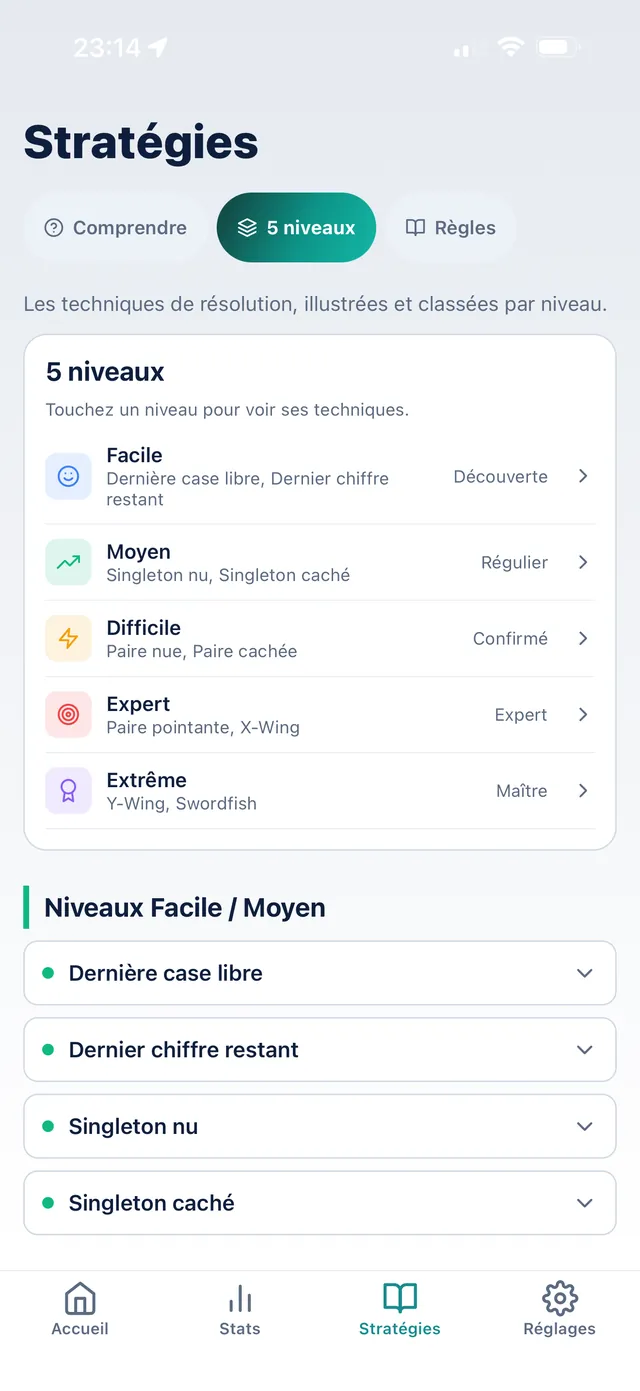
Easy level: seeing what is already there
Last free cell
When a row, column or 9-cell box has only one empty cell left, the missing digit is obvious: it is the only one from 1 to 9 not yet present. This is sudoku's most basic move.
Last remaining cell
Pick a digit, say 7, and look at a box where it is missing. The 7s already placed in neighbouring rows and columns rule out certain cells of the box. If only one possible cell remains, the 7 goes there. This grid-scanning read is also called cross-hatching.
Medium level: the singles
Naked single
A cell whose constraints (row, column, box) eliminate eight digits out of nine has only one possible candidate left. Note candidates in cells using pencil marks, and naked singles jump out at you.
Hidden single
A cell may hold several candidates, but if one of them appears nowhere else in the row, column or box, it can only go there. The candidate is "hidden" among the others, hence the name.
Hard level: the same singles, fewer clues
A Hard grid asks for no new technique. It starts with fewer digits than a Medium grid and is built so that scanning the boxes is no longer enough to finish it. At least once, you will need a hidden single found in a row or column, or a naked single.
Expert level: crossing constraints
Pointing pair
When, inside a box, a candidate only appears on a single row (or column), it will necessarily be placed in that box on that row. You can therefore eliminate it from the rest of the row, outside the box. If the candidate sits in three cells of the box, the same rule is called a pointing triple.
Claiming
The reverse move. When, inside a row (or column), a candidate only appears within a single box, it will necessarily be placed in that box on that row. You can therefore eliminate it from the other cells of the box.
Extreme level: pairs, triples and patterns
An Extreme grid is built to require at least one of the following techniques, where singles and the Expert techniques run out.
Naked pair
Two cells in the same unit holding exactly the same two candidates, say 2 and 5. Those two digits are reserved for those two cells: you can erase them from every other cell in the unit. Grids often crack open right after.
Hidden pair
The mirror image: two candidates that only appear in two cells of a unit. Those cells belong to them, so all their other candidates can be erased.
Spotting hidden pairs on a verified grid
Naked and hidden triples
The same reasoning works with three. Three cells of a unit that hold only three candidates between them keep those digits for themselves. You erase them from the rest of the unit. Conversely, three candidates locked into the same three cells push every other candidate out of those cells.
X-Wing
A candidate that appears in only two columns across the same two rows forms a rectangle. Whichever diagonal turns out correct, both columns are taken: the candidate disappears from the rest of those two columns. X-Wing is the gateway to advanced play.
Y-Wing
Three two-candidate cells forming a pincer: a pivot cell AB sees a cell AC and a cell BC. Whether the pivot is A or B, one of the two branches contains C. Any cell that sees both branches therefore cannot contain C.
Finding the Y-Wing pincer in a real grid
Swordfish
X-Wing's big brother, across three rows and three columns. A candidate confined to three columns across three rows gets eliminated from the rest of those columns. Rare, spectacular, and indispensable on some Extreme grids.
Improving without burning out
The secret is not learning all fourteen techniques at once, but climbing one tier at a time: play at the level where your new technique is required, until it becomes automatic. SudoKoum's statistics show your average time per level, which makes the moment to move up very easy to read. And to spice up the learning, nothing beats a challenge against a friend at the same level.
Notify me when available · All guides
Guide published by Kaizen Suru, maker of SudoKoum. Technique names vary across sources, we use the ones from the app.
Be there at launch
SudoKoum is coming to the App Store and Google Play. Leave your email and get a single message, the day the app ships.
Notify me when available