The X-Wing sudoku technique needs four cells and one digit
An X-Wing follows one digit across two rows. In each row the digit fits in only two cells, and those four cells sit in the same two columns. The digit has to land on one diagonal of that rectangle, so you can remove it from every other cell in both columns. Swap rows and columns and the same logic holds.
What does an X-Wing look like on a real grid?
Here is one built on the digit 9. Cells are named by row and column, so r4c6 means row 4, column 6. A candidate is a digit that can still go in an empty cell.
Start with row 4. It has five empty cells, in columns 1, 4, 6, 7 and 9. The 9s already placed in r9c1, r1c4 and r2c7 rule out columns 1, 4 and 7. That leaves the 9 of row 4 with two cells, r4c6 and r4c9.
Row 8 ends up with the same pair. Its empty cells in columns 4 and 7 sit under those same placed 9s, so the 9 of row 8 can only go in r8c6 or r8c9. Those four cells are the corners of the X-Wing.
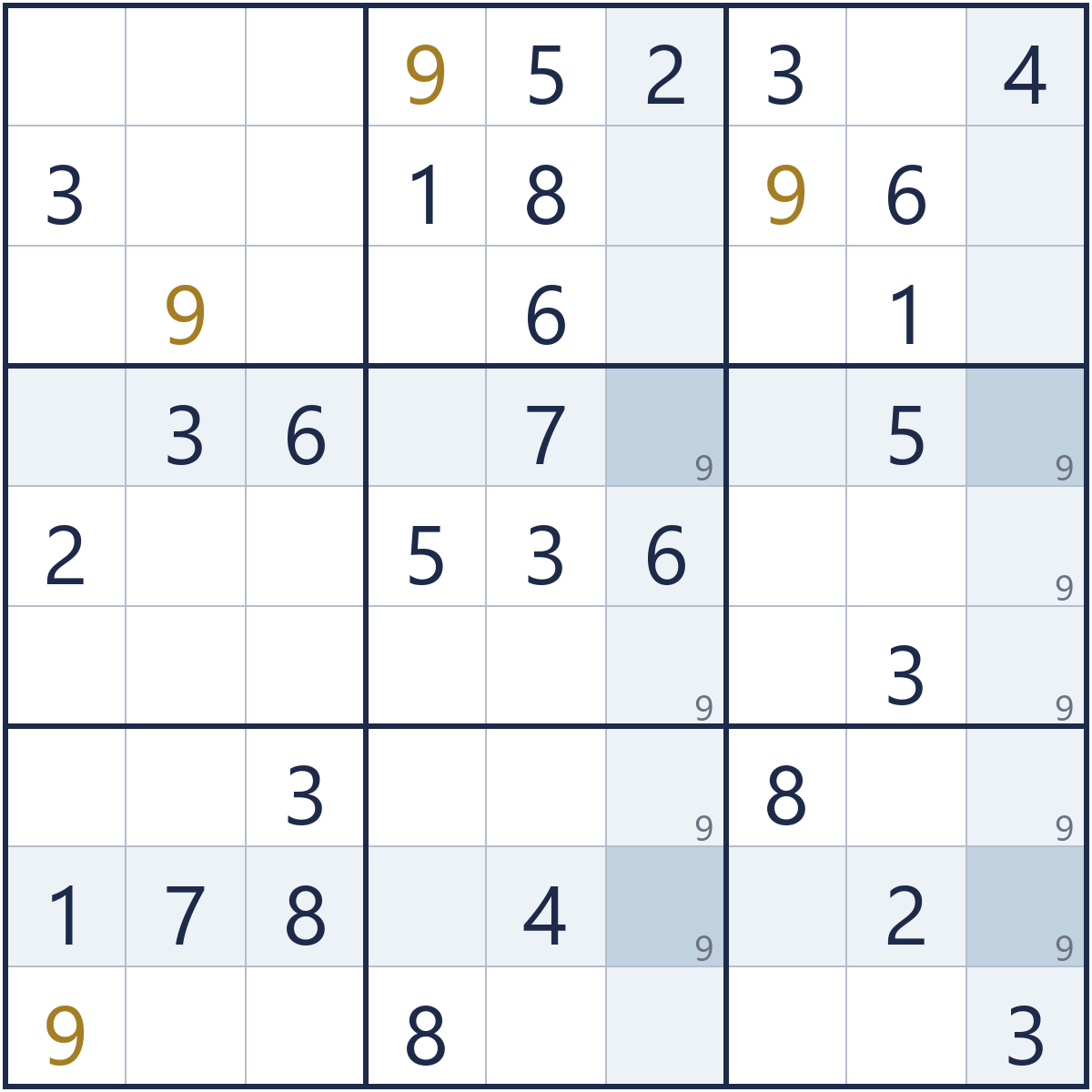
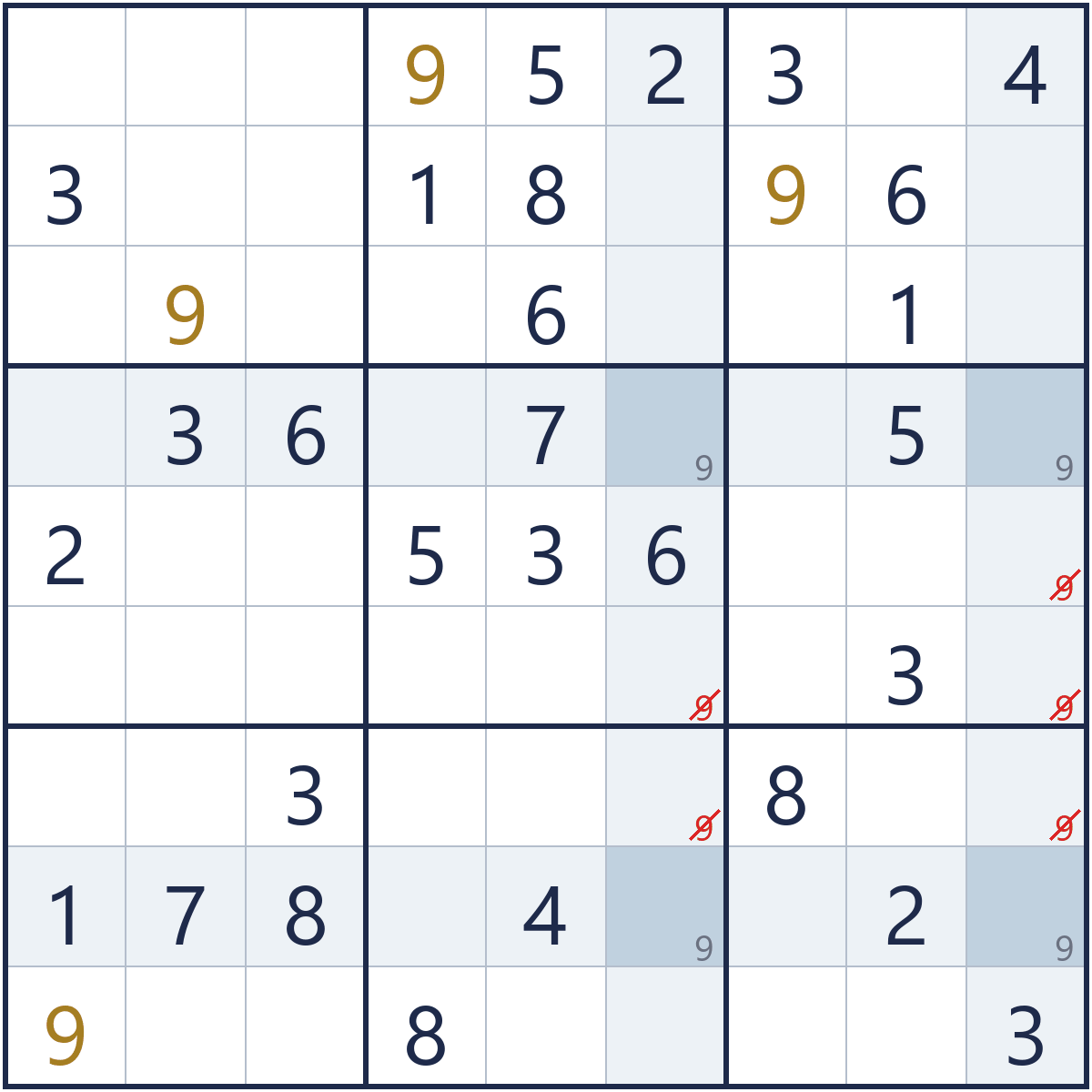
Five candidates go. In column 9 they are r5c9, r6c9 and r7c9, in column 6 r6c6 and r7c6. The four corners keep their 9. This grid was checked by script before publication. It has one solution, and none of the eleven techniques the Strategies screen lists before the X-Wing, from last free cell to hidden triples, makes these five removals.
Why can you remove the 9 before you know where it goes?
Because both possible placements fill the same two columns. Put the 9 of row 4 in r4c6 and column 6 is taken, so the 9 of row 8 has to go in r8c9. Put it in r4c9 and column 9 is taken, so row 8 gets its 9 in r8c6.
Either way, columns 6 and 9 each receive a 9 in row 4 or row 8. A column holds one 9, so no other cell in those two columns can take one. You don't guess. You look at the only two cases and keep what they agree on. Each case fills one diagonal of the rectangle, and the two diagonals draw the X in the name.
How do you spot an X-Wing step by step?
Work one digit at a time. Pencil marks, the candidates you write in small digits inside each cell, have to be complete for that digit.
- Pick a digit and pencil it into every cell where it still fits.
- Find a row where that digit has exactly two candidate cells.
- Find a second row where it also has two, in the same two columns.
- Remove the digit from every other cell in those two columns and leave the four corners alone.
- Run the same search on columns, then remove the digit along the two rows.
- Look for singles in the rows, columns and boxes you just changed.
A short note in the margin speeds this up. For the digit you are checking, write down each row that has exactly two candidates, with its two columns: "row 4, columns 6 and 9". Two rows with the same pair of columns are an X-Wing. In the example grid, rows 4 and 8 both carry the pair 6 and 9.
When should you look for an X-Wing?
Once singles, pairs and pointing pairs stop giving you anything. An X-Wing asks you to compare two rows that may sit far apart, which takes longer than scanning a box. Look for it too early and you can miss a simpler move that would have opened the grid.
The sudoku techniques guide puts the X-Wing at Extreme level, next to pairs, triples, the Y-Wing and Swordfish. If you don't have a fixed scanning order yet, start with how to solve sudoku step by step and come back here when the easy moves run out.
When does an X-Wing fool you?
Missing pencil marks cause the costliest mistake. If you forgot to write the 9 in one cell of row 4, the row seems to have two candidates when it really has three. The 9s you remove next may include the one that belonged there. Before you erase anything, recount the digit in both rows.
Two rows with two candidates each are not enough on their own. The four cells have to share the same two columns. If the rows share only one column, you may be looking at a Skyscraper, a different pattern with its own logic. If they share none, that pair of rows gives you no X-Wing.
An X-Wing built on rows removes candidates from columns. Rows 4 and 8 have nothing left to lose, since their 9s already sit in the corners. For an X-Wing built on two columns, flip it and remove along the two rows.
Some X-Wings are real and useless. If the digit appears nowhere else in the two columns, the pattern removes nothing. Move on to the next digit.
How does the X-Wing compare with Swordfish and Y-Wing?
Swordfish stretches the X-Wing to three rows. Y-Wing works on a different idea altogether. The table sets the three side by side, based on how each technique is defined.
| Technique | Digits involved | Cells in the pattern | What you remove |
|---|---|---|---|
| X-Wing | One | Four cells on two rows and two columns | The digit, elsewhere in the two columns (or the two rows) |
| Swordfish | One | Six to nine cells on three rows and three columns | The digit, elsewhere in the three columns (or the three rows) |
| Y-Wing | Three | Three cells with two candidates each | The digit shared by the two outer cells, from any cell that sees both |
Questions about the X-Wing
Does an X-Wing work with columns too?
Yes. If a digit has two candidates in one column and two in another, on the same two rows, remove it from the rest of those two rows. It is the row version turned a quarter turn.
Do you need every pencil mark to find an X-Wing?
For the digit you are checking, yes, across the whole grid. The other digits can wait. Marking one digit at a time keeps the grid readable and the rectangle easier to see.
Is an X-Wing the same as an XY-Wing?
No. XY-Wing is another name for the Y-Wing, which links three cells that each hold two candidates and involves three digits. The X-Wing tracks one digit over two rows. The Y-Wing guide walks through one on its own grid.
What should you learn after the X-Wing?
Swordfish. It runs the same check on three rows and three columns, with two or three candidates per row. It is harder to see because its cells no longer form a simple rectangle. In SudoKoum, the Strategies screen shows X-Wing and Swordfish among the app's 14 techniques.
Do easy grids ever need an X-Wing?
An easy grid that falls to singles needs none. The X-Wing earns its place once simpler techniques stop removing candidates.
How can you practice spotting X-Wings?
Cover the second image above and find the five 9s to remove on your own. On your next hard grids, list the rows with two candidates for one digit, then move to the next digit. You can also challenge a friend on the same grid.
Be there at launch
SudoKoum is coming to the App Store and Google Play. Leave your email and get a single message, the day the app ships.
Notify me when available